Use cases
AI video ads: refresh creative without a production cycle
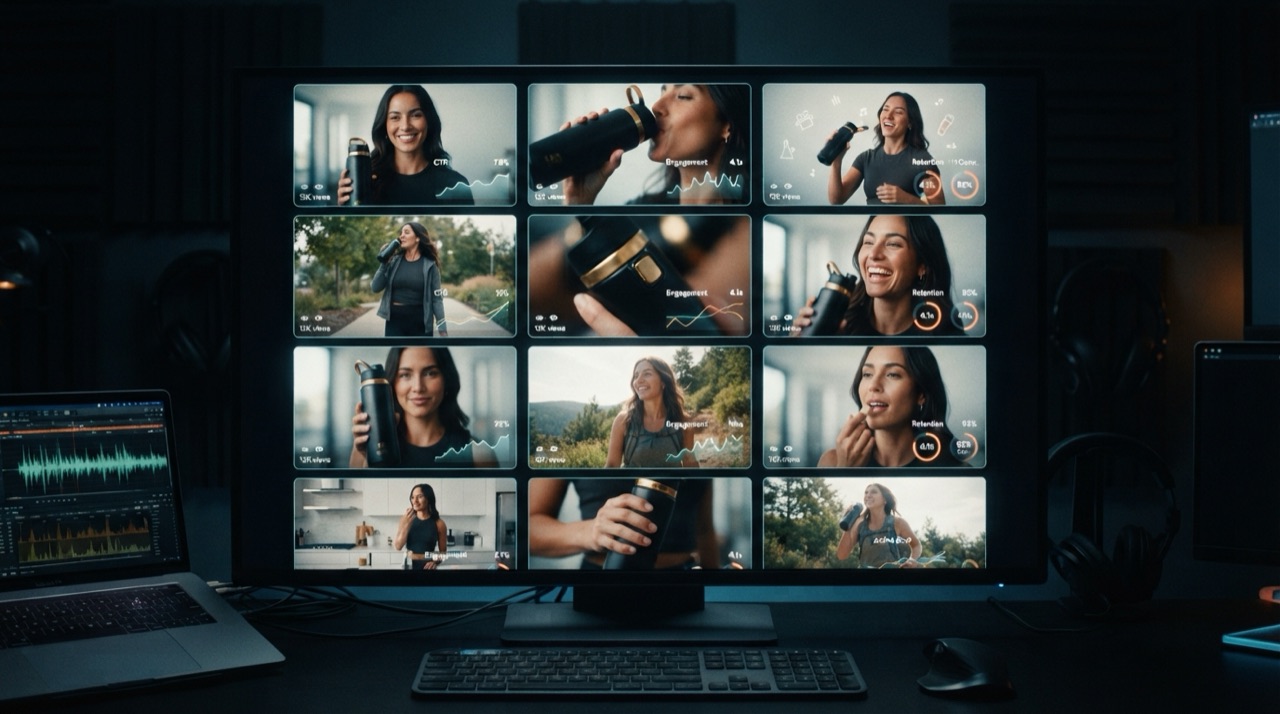
A video ad that performs well today rarely keeps performing for long. Audiences see it enough times that it stops converting, usually within a couple of weeks, and by then the next version needs to already be in production. The problem is that "in production" for a video ad usually means a shoot, an editor, a round of revisions and a turnaround measured in days, right when the account needs a fresh variant immediately.
Why ad creative burns out faster than teams can produce it
Performance marketers already know the fix for a fatigued ad is a new one, not a bigger budget on the old one. The bottleneck is rarely the idea. Someone usually has three or four hook ideas ready to test. What is missing is the capacity to produce all of them fast enough to matter, since each one competing for the same editor's time and the same shoot day pushes the others back a week.
By the time the fourth variant is ready, the first one has often already faded further, and the account ends up running a stale ad for longer than intended simply because production could not keep pace with how fast performance actually decays.
Generating ad variations from a description
An AI video model can produce a finished ad-style clip directly from a prompt: a product demo, a testimonial-style hook, a before-and-after comparison. You describe the product, the angle and the offer, and the clip comes back already framed and paced for a feed, without booking a shoot or waiting on an editor's calendar.
Testing several hooks without multiplying the cost
Because each variation is a new prompt rather than a new production, testing five hooks costs roughly the same as testing one, in time if not in generation credits. That changes the economics of creative testing: instead of picking the one idea a team can afford to produce well, every reasonable idea can get tested, and the ones that do not perform cost a fraction of what a wasted shoot would have.
Keeping the product and spokesperson consistent across variants
A batch of ad variants still needs to look like one campaign, same product, same presenter if there is one, same visual identity, across every hook. StoryStudio's Cast & World feature locks a product or a presenter's look from a reference image once, and every following generation in the project reuses it automatically, so ten hook variants read as one coherent campaign rather than ten disconnected clips.
From a prompt in chat to a ready-to-test ad
This runs from an MCP-connected agent like Claude or Cursor. You connect StoryStudio once, then describe each ad variant in plain language: the hook, the product, the call to action, the mood. StoryStudio routes the request to a video model suited to the shot and returns a finished clip in the same conversation, ready to upload to the ad account.
FAQ
Does this replace a creative team entirely? Not necessarily. It removes the production bottleneck for testing volume, so a creative team can focus on ideas and offers rather than on shoot logistics for every variant.
Can I keep the same product or presenter across every ad variant? Yes, using StoryStudio's Cast & World feature, which locks a look from a reference image once and reuses it across every following generation in the project.
How fast can a new ad variant be ready? Generation typically takes seconds to a few minutes depending on the model, compared to a shoot-and-edit cycle that usually takes days.
Ready to refresh your ad creative without the production cycle? Start with StoryStudio.
Pricing: Free (5 credits, P-Image only) · Creator €14.99/mo (1,200 credits) · Pro €39.99/mo (3,500 credits) · Recharge €59.99 one-off (5,000 credits, no subscription). See full pricing →